
The Unexpected Coaching Tools that Help Midlife Women Heal Themselves
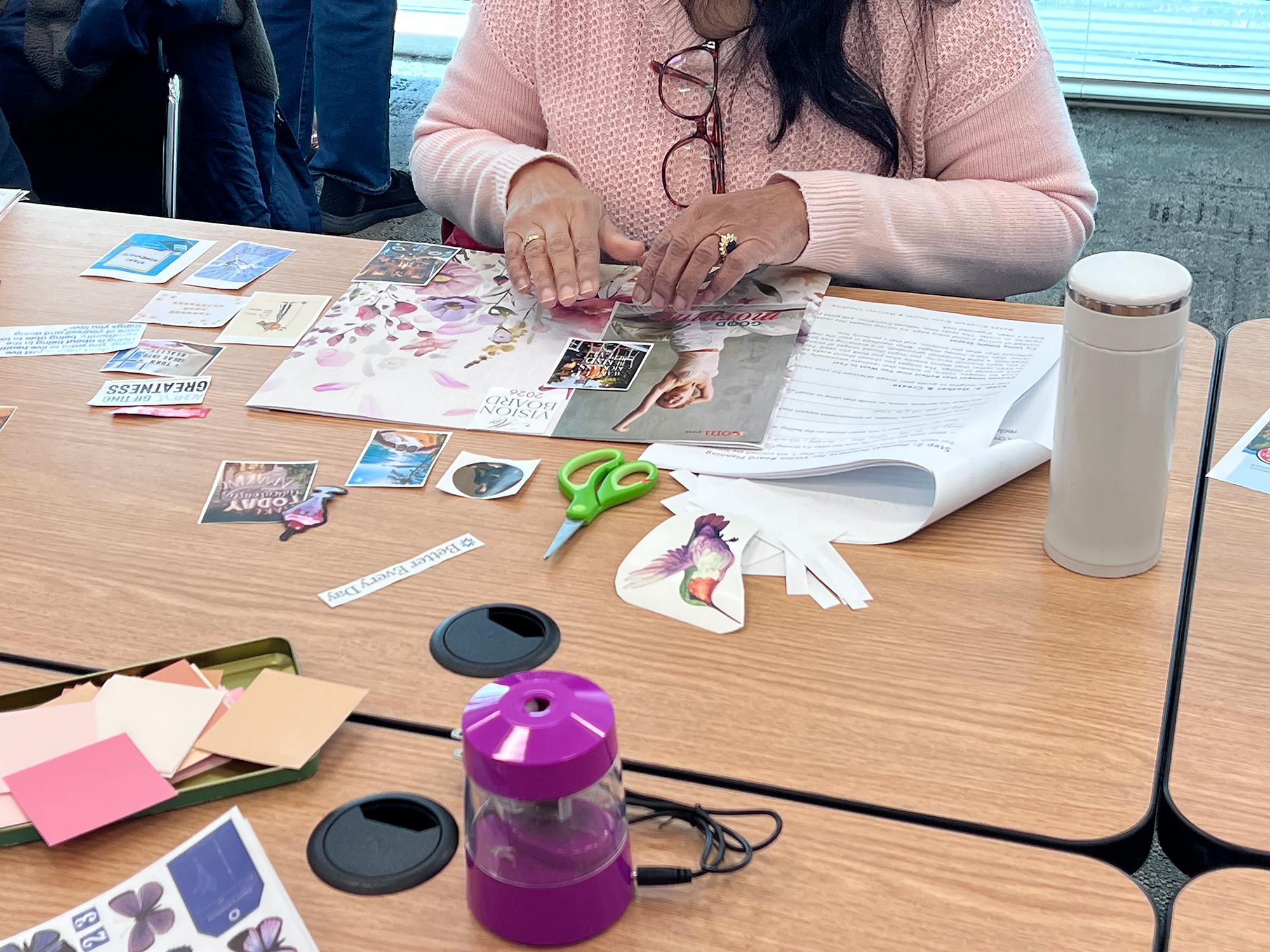
Last month, I held my first workshop of the year. It was a vision boarding workshop geared to midlife women, and it was both extremely successful and personally rewarding. As a former graphic designer and a practicing collage artist, being able to integrate art into my coaching practice has been a long-time desire.
But as a former user experience (UX) designer and researcher, with years of experience facilitating human-centered strategic discovery workshops to help teams build better products, the ability to draw on those skills and offer an immersive, expressive arts experience to groups of women is a dream come true.
Although I have experience and training in expressive arts and art therapy techniques, I am not a trained or licensed therapist, and these workshops, as well as all the expressive arts processes I use in my work, are not a form of therapy, nor a replacement for professional mental health support. Rather, these expressive arts techniques are a means of guided self-reflection. The outcome is actionable self-discovery, enabling each participant to chart their own path to better health, greater happiness, and increased life satisfaction.
Participants at my last workshop reported that they felt curious, hopeful, and a little unsure of what to expect before the workshop, but upon leaving felt inspired, confident, and energized about what was possible for their lives. This improvement in their outlook is consistent with what research suggests about the benefits of expressive arts. But just what are “expressive arts” and how do they contribute to a more positive mental and emotional outcome?
The Answer is Two-Fold
The discipline of expressive arts, as defined by the International Expressive Arts Therapy Association, actually has two different definitions, based on whether or not it is being used in a clinical (i.e., therapeutic) setting. Expressive Arts Therapy and Expressive Arts Facilitation (also referred to as Education and Consultation) are both integrative, intermodal methods of fostering self-discovery and personal growth, utilizing such creative modalities as visual arts, music, dance/movement, drama/theatre, and poetry/writing.
When used in a therapeutic setting by a licensed therapist, the goals of self-discovery and growth are to promote healing, process trauma, and/or treat mental or emotional illness for the purpose of diagnosis, the development of treatment goals, and the implementation of clinical outcomes.
When performed by an educator, consultant, or facilitator not licensed as a therapist, self-discovery can help participants gain clarity and insight, as well as experience deep personal growth. It can also foster decision-making, community development, and creative expression. Here, rather than diagnosis and treatment, the focus is on exploration and awareness.
How Expressive Arts Help
1. Cultivate Deep Self-Reflection
Whether by oneself, with a group, or in a clinical setting, the processes of self-reflection and discovery are just as important as the act of creating art. Without the former, the latter is just a fun arts and crafts session.
Research led by Girija Kaimal, Professor and Chair of the Creative Arts Therapies Department at Drexel University, found that art-making actually lowered cortisol levels in approximately 75% of participants, irrespective of age, gender, race, ethnicity or prior art experience. And those participants who claimed they actually learned something about themselves while making art were slightly more likely to experience a reduction in cortisol levels.
Given the higher levels of stress that women often experience during the menopause transition years, opportunities for self-reflection, self-discovery, and art-making could not only help with stress management but also create space for women to consciously engage with and make sense of the internal shifts they experience during this life stage.
Insights and discoveries can either precede or emerge from the art-making process itself. For example, journaling is a great pre-art-making method of arriving at profound realizations, which can then inform the art itself. Conversely, the intuitive art practice of SoulCollage® draws on Jungian psychology to help individuals get in touch with their deeper selves or 'souls' through both writing and collage art.
2. Facilitate Narrative Meaning-making
Expressive arts can lead to a deeper sense of meaning-making, the process of organizing experiences into coherent narratives. Research on expressive writing, particularly the work of psychologist James Pennebaker, has explored how structured reflection supports meaning-making.
Translating thoughts into language can help clarify and reframe emotionally significant events. But when reflection moves beyond language into visual construction, meaning is not only articulated, it is assembled. This is the power of visualization.
Visual symbolism allows complex emotional states and identities to be expressed without requiring precise verbal articulation. The act of selecting and arranging images not only helps make our thoughts and feelings tangible and memorable but enables us to better organize scattered thoughts. As we experience this deeper self-reflection, insights can emerge through self-expression.
3. Encourage Tactile Involvement
Creative processes such as collage engage the hands as well as the mind. Cutting, arranging, and assembling require fine motor coordination and sustained attention. Drawing, painting, beading, even doodling and knitting, are effective means of sensory engagement.
Connecting abstract thoughts to physical engagement naturally slows the pace of thinking and helps to ground the nervous system. This tactile involvement has been shown to reduce stress and improve overall well-being.
4. Disrupt Rumination through Creative Focus
Rumination is a well-documented pattern of repetitive negative thinking. Participating in expressive arts can help shift the brain’s attention away from these stressful thought patterns and into purposeful activity. Research on rumination and art-making by art therapist Girija Kaimal has shown that these cognitive mental loops tend to sustain distress rather than resolve it.
Structured, immersive, goal-directed creative engagement offers an alternative, not by erasing stress, but by organizing attention and breaking the mental loops that fuel burnout. Through a meditative focus on the present task, the brain is freed from past or future worries.
5. Access “Flow” to Replenish Emotional Energy
The concept of “flow” was first introduced back in the 1970s by psychologist Mihály Csíkszentmihályi. When someone is in the “flow state,” also known as being “in the zone,” they are so fully immersed, so absorbed, and so completely fulfilled by their activity that they lose track of themselves and of time.
A form of mindfulness, flow provides us with an “optimal experience” in which we are intrinsically motivated simply by the act of doing. This effortless focus serves as a mental break, reducing stress and anxiety, and generating feelings of enjoyment, competence, and renewed purpose.
By fully immersing the mind in a challenging yet achievable activity, such as a repeatable craft, flow quiets the brain’s “inner critic,” allowing our emotional resources to be recharged rather than depleted.
6. Support Nervous System Regulation
The physiological impact of expressive arts is profound. The act of “creating” supports a transition in the body’s nervous system from a “fight or flight” stress response to a more regulated “rest and restore” state. By lowering stress hormones like cortisol, the creative process helps recalibrate the nervous system, supporting the release of the “happy hormones” dopamine, serotonin, and oxytocin. This is especially true in a group setting, where art-making can foster social connections.
Such nervous system transformation helps support enhanced cognitive clarity, improved sleep quality and digestion, as well as a sense of general well-being. A multinational research study found that creative engagement provides cumulative benefits, similar to a good diet or exercise. Studies with older adults have found that creative pursuits, such as painting, scrapbooking, gardening, or learning a musical instrument, can actually slow down the brain’s aging process by enhancing brain plasticity and memory.
7. Nurture Emotional Resilience
The positive effect of art-making is not just limited to physical health. Studies have found that creative engagement also leads to emotional resilience and self-esteem, which can in turn lead to lasting life changes. This is the ultimate goal of my expressive arts workshops.
By repeatedly engaging in this cycle of discovery and regulation, individuals strengthen their ability to bounce back from life’s stressors and build the long-term resilience needed to handle high-pressure environments without becoming overwhelmed. Beyond its tactile appeal, the physical act of ripping and tearing, often a precursor to collage assembly, can provide the bonus of cathartic release from stressors associated with burnout. This sustainable approach to emotional health alleviates the roots of burnout and provides a toolkit for navigating future challenges with confidence.
Burnout often requires systemic change, adequate rest, and in some cases professional support. While expressive arts are not a substitute for structural burnout prevention strategies, they can serve as a complementary practice that enhances emotional regulation, emotional processing, creativity, and, in a corporate setting, team cohesion.
In the workshops I’ve developed, I draw on collage, journaling, and other expressive arts approaches to help women explore identity, purpose, body image, and the ways they have grown and evolved over time in a participatory, reflective setting that helps them clarify the direction in which they want to move forward. This kind of structured, participatory reflection has relevance beyond personal growth.
The same principles that support clarity and discernment in individuals also strengthen engagement, cohesion, and intentional decision-making within teams. When people are given space to reflect, articulate priorities, and contribute creatively, motivation and collaboration naturally deepen. In a world saturated with information and advice, experiences that help people think, reflect, and create meaning for themselves offer something different. That difference is not better information, but deeper integration.
If you are looking to improve your health and wellbeing and feel you might benefit from an expressive arts approach, or if you are interested in hosting an expressive arts workshop at your company or organization, book a 15-minute discovery call to learn how I can help.
The information in this article is intended for educational purposes only and is not a substitute for medical advice. Nothing in this article is intended to diagnose, treat, prevent, or cure any disease. Always consult with your healthcare provider before making any dietary, lifestyle, or supplement changes, and do not forego, delay or disregard medical advice based on the content shared in this article. Please consider your personal situation and individual needs and do your own research.
SOURCES
Glossary of Common Terms- The International Expressive Arts Therapy Association
At Any Skill Level, Making Art Reduces Stress Hormones - Drexel University News
Reduction of Cortisol Levels and Participants' Responses Following Art Making - Art Therapy
Making Art Activates Brain’s Reward Pathway – Drexel Study - Drexel University News
About SoulCollage® - SoulCollage.com
Speaking of Psychology: Expressive writing can help your mental health, with James Pennebaker, PhD- American Psychological Association
Collage Care: Transforming Emotions and Life Experience with Collage – Laurie Kanyer, Kanyer Publishing, 2021
The Therapeutic Benefits of Beading: Unleashing the Soul’s Creativity - Awesome Pattern Studio
The benefits of knitting for personal and social wellbeing in adulthood: findings from an international survey– British Journal of Occupational Therapy
Mindfulness-Based Art Therapy with Hospitalized Depressed Individuals – The Temporal Order of Change in Mindfulness, Rumination, and Affect - Journal of Happiness Studies
Thinking too much: rumination and psychopathology- World Psychiatry
Flow (psychology) – Wikipedia
Mihály Csíkszentmihályi: The Father of Flow- Positive Psychology
The Science Behind Art Therapy and Emotional Regulation - The Art Therapy Resources Hub
How Making Art Can Provide a Wellspring of Health Benefits- Blue Zones
Your Brain on Art: The Healing Power of Expressive Arts - Rush University
Why Do People Enjoy Art? Unveiling How Creativity & Beauty Brush Away Stress & Elevate Mental Wellness - Farnsworth Museum